Reasonable Suspicion Testing in Minutes: Onsite Collections When Time-Sensitive Testing Matters
September 14, 2026 · RC Team
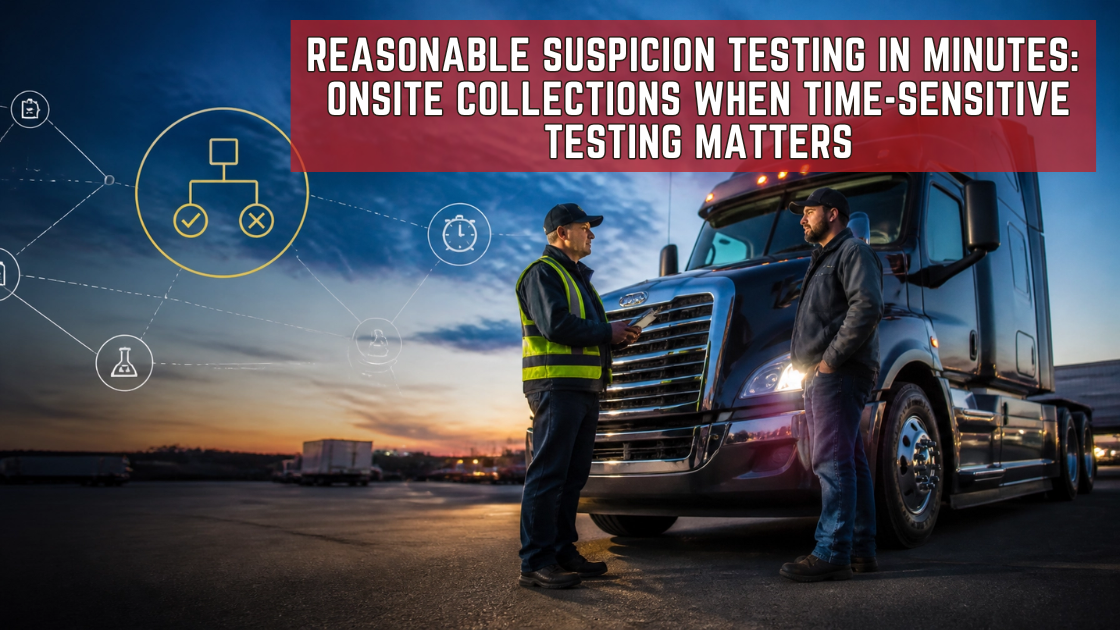
A driver arrives at a customer site, terminal, or truck stop and seems noticeably different. Their speech is unclear, their movements are unsteady, or you observe another specific sign that raises a legitimate safety concern. When that happens, waiting several hours for the driver to reach a clinic can create unnecessary risk, especially when the driver is far from your office or operating outside normal business hours.
READI Collect helps you respond quickly by connecting your company with a trained mobile collector at the driver’s location. Through the READI Collect app and web portal, you can request an onsite reasonable suspicion collection, track the request in real time, and maintain detailed records of when each step occurred. The technology supports your compliance process, while your trained supervisor and designated employer representative remain responsible for making the testing decision.
WHY REASONABLE SUSPICION TESTING REQUIRES A CAREFUL RESPONSE
Under 49 CFR §382.307, a DOT-regulated employer must require a driver to submit to an alcohol or controlled substances test when the employer has reasonable suspicion that the driver violated the applicable alcohol or controlled substances prohibitions. The decision cannot be based on a rumor, a general feeling, or a complaint that someone else made. It must be based on specific, contemporaneous, and articulable observations concerning the driver’s appearance, behavior, speech, or body odors.
That standard protects both public safety and the employee’s rights. It gives you a clear framework for acting on observable facts without treating every unusual situation as proof of impairment. It also means your supervisor must be able to explain what was observed, when it was observed, and why the observations justified testing.
The practical challenge is that trucking operations rarely happen in one convenient location. A driver may be at a remote customer yard, a highway rest area, a truck stop, or hundreds of miles from the nearest occupational health clinic. READI Collect’s onsite collection service is designed for exactly these time-sensitive situations.
> Quick Tip: Do not delay a reasonable suspicion decision while trying to find a clinic that is open and available. Once the required observations have been made and documented, request a mobile collection immediately while following your company’s safety and transportation procedures. Faster access to a qualified collector gives you a better opportunity to complete the process promptly and preserve a clear record of your response.
WHAT COUNTS AS DOT REASONABLE SUSPICION?
For a DOT reasonable suspicion test, the observation must be personal and current. The supervisor or company official must have completed the training required under 49 CFR §382.603, and the observation must relate to signs that could indicate alcohol misuse or controlled substance use. For controlled substances, the regulation also allows observations involving chronic-use or withdrawal effects.
When assessing a situation, your trained supervisor should focus on observable facts such as:
Appearance: Bloodshot or glassy eyes, excessive sweating, unusual pallor, tremors, or an unsteady gait.
Behavior: Erratic actions, unsafe conduct, unusual aggression, confusion, extreme agitation, or difficulty completing familiar tasks.
Speech: Slurring, unusually loud or soft speech, incoherent statements, or difficulty responding appropriately.
Body odors: The smell of alcohol, marijuana, or another unusual substance.
Timing: For an alcohol test, the observations must occur during, just before, or just after the driver’s work period when the driver is required to comply with Part 382.
The supervisor should document the date, time, location, driver’s identity, and specific observations in writing. Under §382.307, the written record must be signed by the supervisor or company official within 24 hours of the observed behavior or before the test results are released, whichever comes first. A mobile collection does not replace this documentation; it gives you a practical way to move from a properly supported decision to testing without losing valuable time.
THE ROAD-BASED CHALLENGE: YOUR DRIVER MAY BE HOURS FROM A CLINIC
Reasonable suspicion situations often involve drivers who are away from the terminal. A supervisor may receive a report from a customer or dispatcher, speak with the driver by phone, and then need to arrange an in-person evaluation or follow established company procedures. A secondhand report alone is not enough to establish DOT reasonable suspicion, but it may prompt the trained supervisor to make a direct observation and assess the situation.
Once the required signs are observed, the driver should not continue performing safety-sensitive duties while the situation is being handled. Finding a clinic may take time, particularly at night, on weekends, or in rural areas. Sending the driver across town or asking them to travel alone may also create additional safety and transportation concerns.
READI Collect lets you request an onsite collection wherever the driver is located. The patented platform sends the request to available mobile collectors in the network, helping you avoid late-night searches for an open facility and reducing the time between the supervisor’s decision and the collection.
HOW READI COLLECT SUPPORTS A FAST ONSITE RESPONSE
The process begins when an authorized manager, supervisor, driver, or designated employer representative logs in through the READI Collect web portal or mobile access. You provide the collection location, donor information, test details, and any other information needed for dispatch. The built-in workflow and decision support can help reduce uncertainty about the next administrative step, but the employer’s trained supervisor remains responsible for determining whether DOT reasonable suspicion exists.
A typical response process includes:
Make the observation: A trained supervisor personally observes specific signs involving appearance, behavior, speech, or body odors.
Document the facts: Record what was observed, when it occurred, where it occurred, and who made the observation.
Remove the driver from safety-sensitive work: Follow your written policy and applicable DOT requirements while arranging the test.
Request the collection: Use READI Collect to submit the onsite testing request from a computer or mobile device.
Connect with a mobile collector: The request is dispatched to available professionals who can travel to the driver’s location.
Monitor the event: Use real-time status updates and time-stamped activity records to follow the request through completion.
Retain the records: Keep the signed observation documentation, collection paperwork, and related records according to your DOT program and company policy.
The READI Collect request-a-collection tutorial provides additional guidance on submitting a request. If you need a planned collection for a facility, hiring event, or scheduled testing window, you can also use the onsite collection scheduling page.
WHY IMMEDIATE ONSITE TESTING STRENGTHENS YOUR DOCUMENTATION
Speed matters because the circumstances surrounding suspected impairment can change quickly. A driver’s condition, location, availability, and ability to provide a specimen may all become more difficult to manage as time passes. For DOT alcohol reasonable suspicion testing, §382.307 requires the employer to document the reasons if the test is not administered within two hours, and the employer must stop attempts after eight hours while documenting why the test was not completed.
An immediate onsite collection does not guarantee a particular test result, and it does not independently prove that an employer followed every DOT requirement. What it does provide is a practical way to reduce avoidable delays and create a more complete timeline of the employer’s response. READI Collect reports can include event initiation details, precise location information, time stamps, and step-by-step activity records that may be useful during an internal review or audit.
Real-time reporting also helps managers coordinate from a distance. Instead of repeatedly calling clinics, collectors, and dispatch personnel for updates, you can monitor the event through the company portal. READI Collect’s geo-fenced tracking and detailed reports help show where and when the collection process occurred, supporting a clearer record of your good-faith compliance efforts.
TRAINING YOUR SUPERVISORS BEFORE AN INCIDENT
A fast collection process works best when your supervisors know what they are authorized to observe and document. DOT requires at least 60 minutes of training on alcohol misuse indicators and at least 60 minutes of training on controlled substances-use indicators for supervisors designated to make reasonable suspicion determinations. Training should emphasize that reasonable suspicion is based on specific, contemporaneous, articulable observations: not stereotypes, assumptions, or an employee’s medical information.
Your company should also identify the people who may initiate or coordinate testing. Depending on your organization, this may include a terminal manager, safety director, operations manager, dispatcher, or designated employer representative. The person who makes the determination that reasonable suspicion exists for an alcohol test may not conduct that alcohol test.
Before an incident occurs, make sure your team knows how to:
Access the READI Collect portal from a phone or computer.
Identify the authorized person who will request testing.
Locate the reasonable suspicion observation form or checklist.
Remove a driver from safety-sensitive work safely.
Provide the collector with accurate location and contact information.
Preserve collection records and related documentation.
Follow your written policy without promising, delaying, or discussing a test result prematurely.
The FMCSA reasonable suspicion guidance explains that these requirements do not apply in the same way to an owner-operator who is both the employer and only employee. However, companies that supervise CDL drivers should ensure their designated supervisors receive the required training and understand their responsibilities.
DOT AND NON-DOT REASONABLE SUSPICION TESTING
DOT testing must follow federal requirements, including the applicable specimen type, testing procedures, documentation, and reporting process. For a CDL driver covered by FMCSA rules, you should not substitute a company policy or an informal screening process for the required DOT test. Your testing provider and collection process must be set up to handle the correct DOT paperwork and procedures.
Non-DOT employers may also need a rapid response when an employee appears impaired or violates a drug-free workplace policy. However, non-DOT testing is governed by the employer’s written policy and applicable state and local law, which may differ from DOT requirements. Before ordering a non-DOT test, confirm that your policy clearly identifies when testing may occur, which employees are covered, what test panel applies, and how results will be handled.
READI Collect supports both DOT and non-DOT onsite collection needs, including time-sensitive reasonable suspicion requests. The convenient approach is to establish your account, understand your workflow, and train authorized personnel before an emergency occurs. You can register your company or review the READI Collect services to determine how onsite testing fits into your program.
A PRACTICAL REASONABLE SUSPICION RESPONSE CHECKLIST
Your written procedure should make the first few minutes easier for the people responsible for safety. It should tell supervisors who to contact, how to document observations, how to protect the driver and public, and how to initiate testing. A clear process also helps prevent inconsistent treatment between employees, locations, shifts, and incidents.
Use this checklist as a starting point:
Confirm that the observer is trained and authorized under your program.
Make a personal observation of specific signs.
Record the appearance, behavior, speech, or body odors observed.
Note the exact date, time, and location.
Keep the driver from performing safety-sensitive duties.
Contact the DER or authorized program administrator.
Request an onsite collection through READI Collect.
Provide accurate location and donor contact information.
Monitor collector response and arrival status.
Maintain the observation record and collection documentation.
Document any delay, inability to test, or refusal according to your policy.
Arrange safe transportation and do not allow the driver to resume safety-sensitive work until permitted.
This checklist should complement: not replace: your company’s drug and alcohol testing policy. If your process is more complicated than your supervisors can follow during an overnight or remote incident, simplify it before you need it. The goal is to make the compliant action the practical action.
IN CONCLUSION: PREPARE FOR THE MOMENT WHEN TIME MATTERS
Reasonable suspicion testing requires more than a quick hunch and more than a test request. You need a trained supervisor, specific and timely observations, accurate documentation, safe removal from safety-sensitive work, and a collection process that follows the applicable DOT or company requirements. When the driver is far from a clinic, onsite collection can help you respond promptly without adding unnecessary travel and delay.
READI Collect connects employers with a nationwide network of mobile collectors through a patented platform built for time-sensitive testing. You can request a collection from your phone or computer, receive real-time status information, and access detailed event records that show what happened and when. That combination of speed, convenience, and documentation helps you focus on safety while your testing response is underway.
Get prepared before the next incident by signing up for READI Collect or scheduling onsite testing. Company subscriptions are available for $39.99 per year after a 30-day free trial, with each collection charged separately based on the collector and test type. For questions about coverage or incident pricing, contact READI Collect.
Helpful search terms
DOT reasonable suspicion testing
49 CFR 382.307 reasonable suspicion
DOT supervisor reasonable suspicion training
onsite reasonable suspicion drug testing
mobile drug and alcohol collector
reasonable suspicion testing for truck drivers
remote DOT testing
time-sensitive workplace drug testing
DOT alcohol testing two-hour documentation
non-DOT reasonable suspicion testing
real-time drug testing status reports
geo-fenced onsite drug testing